



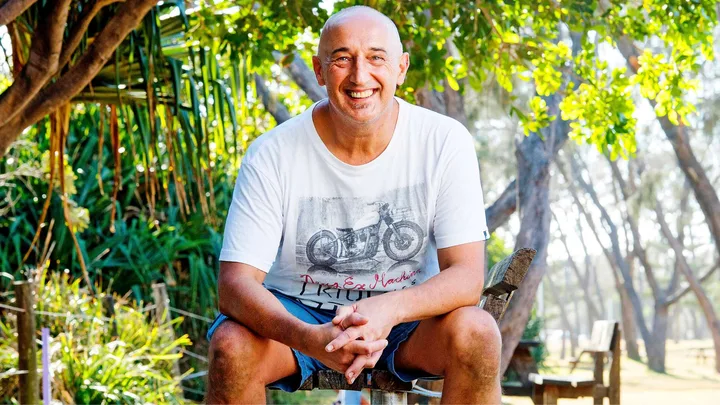
Walter Mikac describes himself as an “ordinary person thrust into extraordinary circumstances”.
But while many would crumble in the face of the unthinkably tragic event that stole his wife and young daughters from him 28 years ago, Walter has somehow managed to use it as motivation to make a life-changing difference to thousands of people.
“My initial response was to draw the curtains and lock myself away in my house, but I realised that was not going to change anything,” the 62-year-old Byron Bay resident tells Woman’s Day. “It wasn’t going to bring them back.”
Walter’s wife Nanette and their daughters, Alannah, six, and Madeline, three, were having a picnic at the historic convict settlement in Port Arthur, Tasmania, on 28 April 1996, when a lone gunman opened fire, killing 35 people in what is still modern Australia’s most deadly mass murder.

Family legacy
Walter was on the nearby golf course and remembers hearing the shots ring out.
“We thought there must be a re-enactment going on, but then some people arrived in a car,” he recalls. “They looked like they’d seen a ghost and said someone was over there shooting people.”
By the time Walter arrived on the scene, it was chaos.
He describes seeing dead bodies on the ground and, having found Nanette’s car in the car park, he started to fear the worst.
Local GP Pam Ireland told him she’d identified the bodies of his family. All three of his loved ones had been killed.
“It was a big blur from then,” he says. “I went back to the site the next day and I saw them. I just thought, ‘How could one person cause all that?’”
That one person having access to an automatic firearm was the answer. Despite his overwhelming grief, Walter’s mission became clear to him.

“I wanted to change the gun laws,” he says. “I wrote [Australia’s then-PM] John Howard a letter. It was pretty simple. I said we have to change our situation so that nobody can purchase enough ammunition to start a war. I thought I owed it to the girls to give them some kind of legacy.”
Just 12 days later, a gun amnesty saw 800,000 firearms handed in. Walter became a guiding force in lobbying for tighter gun-control laws.
“We are not a gun society as a result of what happened and that’s not just a legacy for my family, but for all the people who lost their lives that day,” he says.
But even with these enormous successes, Walter wasn’t done. In 1997, he set up the Alannah and Madeline Foundation, aiming to help children who had experienced extreme violence and trauma.
The idea came from one of the thousands of letters Walter was sent, which gave him purpose and direction.
He confesses, “In the first year, I’d thought, ‘What’s the point of living?’ I’d worked my whole life for what I had and it was all taken in an instant.
“I wanted to impart a sense of hope that this situation will pass with time. It won’t be the same, but there is the possibility for regeneration and a happy, positive life.”
Over the years, Walter has done exactly that for thousands of children, with programmes like the Buddy Bag, giving hope at times of dire need.
The initiative gives kids who have to flee violent homes with nothing at all a backpack full of essential items.
“At their most desperate, they’re handed a cool bag,” explains Walter. “We have thank-you letters from kids who say it’s the first backpack they’ve ever owned and that says it all. It’s like a guardian angel in the form of Alannah and Madeline, and it comes with a teddy, plus all these personal things to give them comfort.”

Part of the solution
In turn, knowing he is part of the solution gives Walter, a pharmacist, great comfort. He knows Nanette would be incredibly proud of how their girls are remembered every day as a result of the foundation.
“Alannah and Madeline’s names are still talked about years on. Their legacy is helping and will continue to way beyond me,” smiles Walter.
“I don’t have the milestones like their 21sts and their weddings, but they are both remembered in such a positive way.”
In his own life, Walter has tried to see the positive side of what’s come from such a tragedy and believes he owes it to his girls to live each day to the absolute utmost because they’re not able to.
“My family has been solid and helped me – Isabella is the highlight,” he says, referring to his 23-year-old daughter. He also describes his partner Bridget as an “absolute rock”.
“She is right with me in wishing they were here but acknowledging they’re not,” he says. “She’s taken on the past and honours that in the way it needs to be honoured.”

Related stories
Native ad body.
Native ad body.

Native ad body.