




 Photography: Deborah de Graaf.
Jenny Rudd remembers exactly where she was sitting when the penny dropped. It was 2006, she was three months pregnant and weeks from her wedding, perched on the steps of a house in London, looking out at the garden.
She recalls, “I remember sitting there and thinking, ‘This is really bad. This is not love.’”
Jenny can’t remember exactly what her husband-to-be had said to provoke the thought. What she does remember is that it wasn’t the first time, and yet she married him anyway, had three children with him and stayed for another seven years.
“I just didn’t recognise it,” says Jenny, now 51.
“I’d never experienced it when I was young or in all of my grown-up life. I don’t think I’d ever really encountered bullying or abuse in relationships until then.”

The moment she realised the truth
It wasn’t until years after she’d finally left that Jenny understood what she’d actually lived through. Sitting in a counselling session for something she thought was unrelated, her counsellor stopped her mid-sentence.
Jenny recalls, “She was like, ‘All these things you’re describing, that’s what emotional abuse looks like.’ Even now, saying it, I feel uncomfortable because so many other people have it so much worse.”
That discomfort is part of the problem.
She explains, “People think, ‘Oh, well, it’s not that bad. He didn’t hit me.’”
Coercive control can be hard to recognise. It builds through everyday exchanges that often look ordinary from the outside.
“It’s always something seemingly innocuous,” Jenny tells.
“Every single thing in isolation looks neutral, but together, they form a pretty big pattern.”



The catalyst came after a year back in England with her three children – then aged between six and four – and watching how her own parents treated her.
She remembers, “Almost immediately I was like, ‘Oh, my gosh, this is what love looks like.’ I realised I wasn’t the nasty, selfish, self-absorbed, manipulative person I was constantly being told I was.”
Turning her pain into purpose
Two days after they returned to New Zealand, Jenny ended the marriage, but the fight wasn’t over. Years later, Jenny received information suggesting her ex-husband was using methamphetamine and she made an emergency Family Court application to have supervised contact.
“I needed to get all these text messages together to prove my children weren’t safe,” she says.
Her lawyer’s instructions were, “Send me everything.”
What followed was one of the hardest weeks of her life. She spent 30 to 40 hours screenshotting years of text messages, reliving every cruel word as she went.
“You massively second-guess yourself. You think, ‘Maybe it was my fault.’”
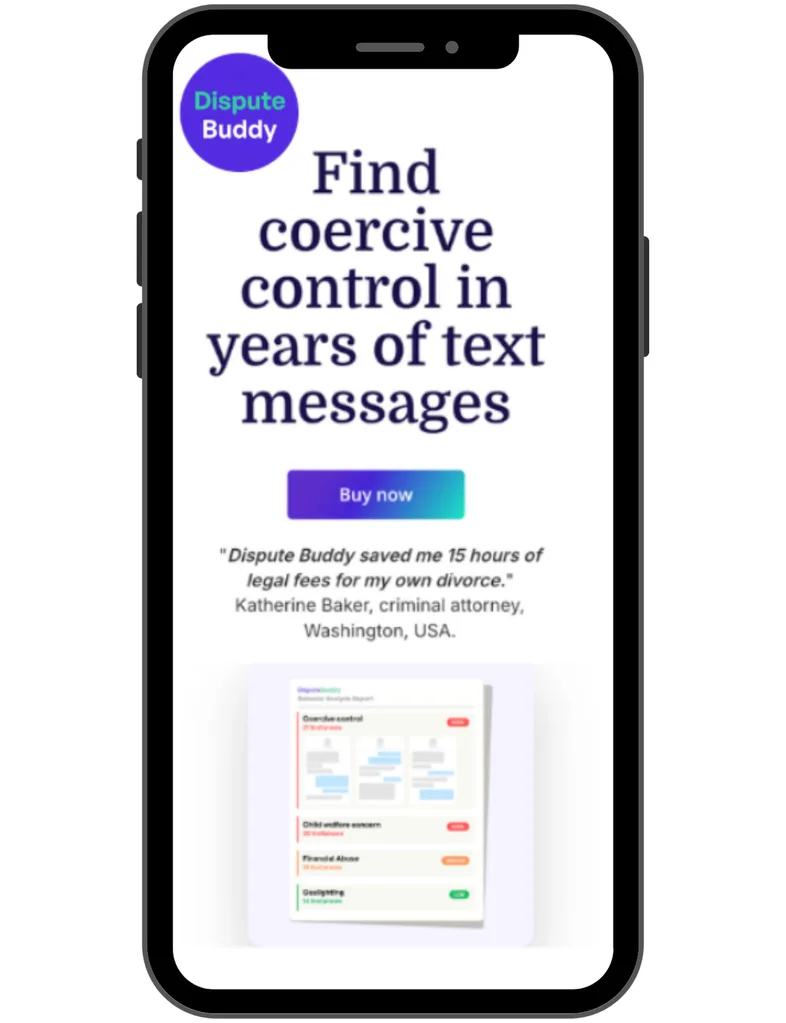
This troubling period stuck with her for years. Realising others faced the same fight, Jenny built a desktop app, Dispute Buddy, that finds patterns of coercive control and emotional abuse in years of text messages, then turns them into a report to give a lawyer.
Her first investor was Dame Theresa Gattung, the former Telecom New Zealand chief executive, co-founder of My Food Bag, and a Dame for her services to women, governance and philanthropy. The pair has also joined forces on the Gender Investment Gap NZ, a project spotlighting the funding shortfall facing female entrepreneurs.
The proof she never expected
Once Jenny built Dispute Buddy, she ran her own messages through it.
The analysis described a “sustained, decades-long pattern of coercive control over Jenny and her children”.
She says, “It was 13 years after I’d left and it was still such a shock to read. But even though a neutral machine had clearly labelled it coercive control, my brain was still saying to me, ‘Nah, it wasn’t that bad.’”
Jenny finds it hard to call herself a victim of anything. It’s a philosophy shaped in part by a life that’s already asked a lot of her. At 24, Jenny survived a motorcycle crash in England that killed both her friend and another rider. She still has only limited use of her right arm as a result. And in 2021, a fall while running left her with a brain injury that took years to resolve.
“I don’t really think about it,” she says of her arm and her head injury.
“It’s not part of my identity.”
What drives Jenny is her impatience with the systems meant to catch coercive control, not for her own story, but everyone else’s.
“Do you coercively control someone in public? No. It’s always in private,” she explains.
“So you’ve got two issues. How do you recall what was said years later? And how do you find the evidence?”
Helping others feel less alone
These days, Jenny hears from women, and men, working through the same realisation she once had, usually long after they’ve left their controlling partner. Talking to them is the part she didn’t expect to find so meaningful, she admits.
“So many of them haven’t spoken to anyone else – no one believes them,” she says.
“They’re lonely, frustrated and trying to process everything that’s happened.”
Her advice for any woman recognising her own relationship in Jenny’s is straight to the point.
She insists, “If you’re ever questioning whether something feels like love, it’s probably not.”
For more about Dispute Buddy, see disputebuddy.co.
Shine’s Domestic Violence Helpline is 0508 744 633 and takes calls 24/7.