




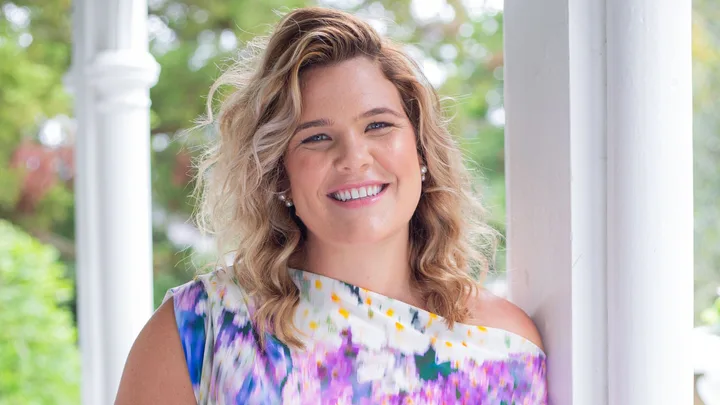
 Photography: Amalia Osborne.
Former war correspondent Lisette Reymer has always had a sneaky habit of not announcing to her family when she’s putting her body on the line for a story. In the past, it’s been flying off to disaster zones of the Ukraine war or earthquakes in Türkiye. This year, Lisette decided to investigate GLP-1 weight-loss injections for Three show Paddy Gower Has Issues by taking Wegovy when it became available on prescription in New Zealand.
After the episode’s promo reel dropped on social media, flashing a shot of Lisette holding a syringe, a text hastily came through from her mother. It quipped, “As long as that’s not heroin, I don’t mind.”
Lisette explains, “Look, I’ll do anything for a story… although I was very scared of the needle. “Initially, when I saw all these celebrities in Hollywood taking Ozempic, I was so judgy of them. I just thought it was an unnecessary, vanity-driven drug. I wouldn’t have gone on it if I wasn’t doing the story.”
“But I thought it would make for great TV if I took it and could show first-hand how weight-loss injections work. The more I researched it, the more evident it became that they can be a hugely valuable medical tool for those struggling with obesity-related health issues. “It’s really hard to get people to talk about weight because it’s an uncomfortable topic. Yet everybody feels something about weight, whether you’ve got a good relationship with your body or you feel uncomfortable in your clothes.”
“That has been so evident in the extraordinary feedback I’ve received. There are lots of people doing things in secret or who are interested in taking it. And lots of people who hated that I took it.”

Understanding obesity
Obesity is a complex disease influenced by biology, genetics, hormones and environment. With a tall, 1.8-metre physique, Lisette’s body mass index was above 30, which categorised her as obese. However, she didn’t have any associated health complications, such as type 2 diabetes or hypertension.
Exposing her journey in a raw, funny and honest way, viewers were able to see how the drug affected the broadcaster physically and mentally. Fairly quickly, nausea set in. She was vomiting in the mornings, feeling “horrendous” and trying to force out bouts of sulphuric burping during breaks while presenting ThreeNews.
The challenges of wegovy
She recalls, “A couple of times, the director would be counting ‘five, four, three…’ and I’d be willing the gas out before I went live. Pretty gross, I know.”
The realisation hit, this was a serious drug. And yet, seven months on from that first jab, she’s still on it – sans any gastrointestinal side effects.
“I really didn’t think I would still be taking it,” says Lisette, who has lost around 20 kilos.
“But because I’ve done so much research, I was cautious that I didn’t want to lose a bunch of weight, then pack it back on in a really unhealthy manner. “The longer I can afford to stay on it, the more chance I have of it being sustainable.” (In New Zealand, Wegovy is not funded by Pharmac, so patients must pay the full cost, around $450 per month.)


Confident in her skin
Today, on an overcast morning in the lush gardens of Auckland’s Alberton historic house, the bubbly 31-year-old happily slips into model mode for our photoshoot. It’s clear she’s comfortable in her skin, but Lisette always has been.
“Honestly, I’ve never really cared about numbers on the scale,” she shares candidly.
“My weight has always yo-yoed, but I’ve thought, ‘Who cares?’ “I’ve also loved representing a different size on TV. So the health benefit for me taking it has mainly come in the form of mental clarity to not overeat, along with the obvious medical benefit of stopping my weight from blowing out further.”
How semaglutide works
Semaglutide, the active ingredient of Wegovy and Ozempic, has been found to reduce cravings. It works by mimicking the natural GLP-1 hormone in the body, which is released in the gut when we eat
and acts on receptors around the body, including the brain, to regulate appetite. GLP-1s reduce what is often called “food noise” – the constant cravings and mental battle with hunger.
Lisette says for her, like others, it offers hope to sticking with healthy habits long-term. She didn’t realise how much constant food chatter was in her head until it was gone.
“I used to always be thinking about my next meal,” she shares.
“Now I go to the supermarket and make sensible food decisions rather than, ‘I’ll get this snack for the trip home, chips and dip for later or this for dessert.’ While previously I’d find it hard to resist eating the leftovers, now I leave them for lunch. “I’m not restricting my diet in any way. I simply don’t notice that I’m not eating as much any more. That’s my new normal.”

A circuit-breaker for healthy habits
It’s been a circuit-breaker in establishing healthier food habits. However, Lisette points out she would hate for weight-loss injections to backtrack all the work that’s been done around body positivity over recent years.
“I feel a huge responsibility to not connect the idea of happiness with weight,” she says.
“At my skinniest, I’ve been the most down. And when I’ve been my heaviest, it was because I was living my best life… having insane work adventures which often meant a crazy sleep schedule, a lot of Ukrainian hot dogs and not having as much time to exercise. I wouldn’t have traded any of that!”
“The thing I’m adamant about is weight is the least interesting thing about a person. If what you take away from talking to somebody is their size, that’s on you. “I can still be the most entertaining person at the table in size 20 pants. I don’t ever want people to think they need to take it just to be a size 10 or whatever. “And I would hate for losing weight to become my personality. People can get obsessed with the numbers on the scale, with not eating and calorie counting. Then you become a pretty dull person to be around.”
Medical support behind the scenes
Before Lisette was prescribed the drug for her TV exposé, medical experts did her full blood work. She found out she has “incredibly low vitamin B12” levels, which runs in the Reymer family.
“I learned B12 is critical if you want to lose weight. Doctors wouldn’t prescribe me Wegovy until I got my B12 levels up, so I’ve been getting B12 injections too.”
Lisette’s also aware the dramatic results of weight-loss drugs often come with a side order of stigma – as though it’s “cheating” not to use diet and exercise alone.
Celebrities overseas, like Made You Look singer Meghan Trainor, have spoken out about the torrent of public backlash to using weight-loss medication, which were originally developed to treat type 2 diabetes.
“I’ve always been an athletic, sporty person – I also weighed 10 pound 10 when I was born. I was set up to be bigger!” laughs Lisette, who was raised on a Waikato dairy farm.
“We need to lose the judgement. These drugs are a powerful medical tool that can change the lives of people in our health system. Of course, with wraparound support too.”

Returning home sparks reflection
Since returning to home soil a year ago, from her three-year stint as Newshub’s Europe correspondent, Lisette has had a time of transformation. Taking inventory of the year that was, when she also released her book No, I Don’t Get Danger Money – Confessions of an Accidental War Correspondent, she reflects that 2025 has been a “weird one” that even had her questioning her identity.
“Covering the Ukraine war feels at times like a distant memory,” she muses.
“I really love being home again in New Zealand, but in some ways, I feel like I’ve almost lost my identity and am trying to find, or re-establish, who I am again.”
Rediscovering belonging in the studio
Yet Lisette no longer has an insatiable craving for living overseas. Reporting in the field, from disaster zones or war zones, will be a life-long passion, but recent stints in the studio, as a newsreader, have given her a new sense of belonging.
“I’ve never really wanted to be a presenter,” she insists.
“I never wanted to be in the studio. I came home to New Zealand and resisted it because I just wanted to be out in the field. “Then our brilliant ThreeNews executive producer was like, ‘You have to give it a go.’ She got me in the studio and I loved it, which I did not see coming. I really didn’t think it was for me. “Now I’m like there’s a whole world there that gives me such a buzz and adrenaline rush again, and a whole new skillset.”
Saying yes to new opportunities
So, Lisette concedes, the lesson she wants to take into this year is to “say yes to things”.
“Previously, I’ve always built a plan of what my journey was going to be,” she says.
“But, actually, my whole career has surprised me. I started out wanting to be an entertainment reporter, then I ended up covering war. So my goal this year is simply to have more of an open mind to where life takes me.”
Lisette will be discussing her book at HamLit on Saturday February 21, 12pm at Hamilton Gardens. HamLit is part of the Hamilton Arts Festival. See hamiltonartsfestival.co.nz